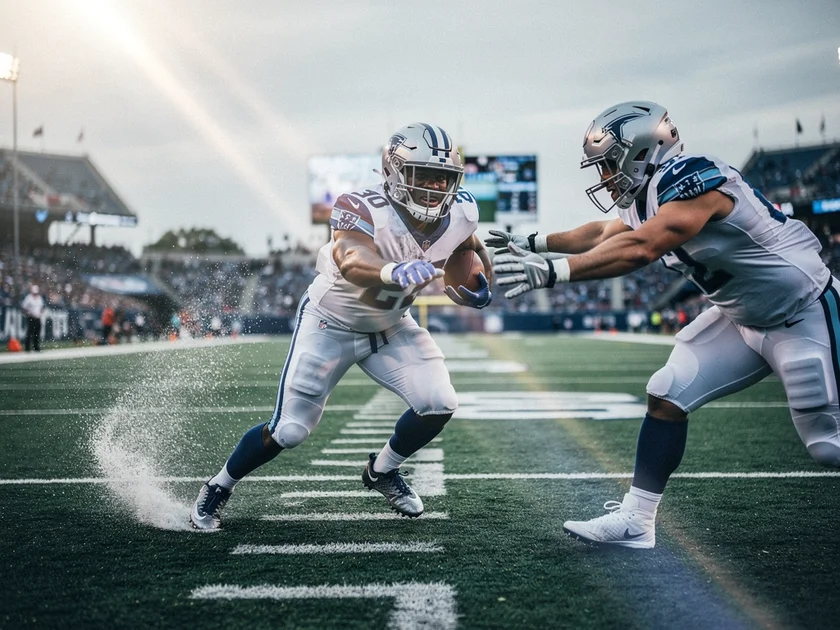
Derrick Henry enters the 2026 NFL free agency period as the marquee name at running back. Rival AFC West franchises are scrambling to address their own backfield needs through a market expected to peak near $12 million per year. ESPN’s Jeremy Fowler reported Sunday that the Kansas City Chiefs and Denver Broncos are both pursuing Jacksonville Jaguars free agent Travis Etienne — framing a bidding environment that will set the floor for every back in this class.
The timing matters. Henry, who turned 32 in January 2026, is coming off a dominant 2024 season with the Baltimore Ravens. He rushed for 1,921 yards and 16 touchdowns — numbers that defied every conventional aging curve for NFL running backs. His free agency draws attention not just because of his output but because of what his contract will signal for the entire positional market this spring.
Henry’s yards-after-contact rate and broken-tackle frequency stayed elite through his age-31 campaign. The physical erosion that typically hits power backs had not yet arrived. Those numbers reveal a pattern of durability that makes his eventual deal a genuine salary cap event, not merely a headline.
The AFC West Bidding War Reshaping the RB Market
The Kansas City Chiefs and Denver Broncos have emerged as the two most aggressive AFC West franchises in the running back market this offseason. Both clubs are showing serious interest in Travis Etienne, the former Jacksonville Jaguar who ranks as the second-most coveted back available behind Derrick Henry. Fowler’s reporting places the top of the RB market at roughly $12 million annually — a figure that will anchor negotiations league-wide.
Kansas City’s need is acute. The Chiefs have cycled through a carousel of underwhelming backfield options since Kareem Hunt’s departure. Their offensive scheme under coordinator Matt Nagy — built around play-action and designed runs off 11 and 12 personnel — demands a back capable of generating positive EPA on early downs. Isiah Pacheco’s injury history has exposed the roster’s fragility at the position, making this offseason a genuine inflection point for Kansas City’s run-game architecture.
Denver’s interest reflects a different calculus. The Broncos are rebuilding around quarterback Bo Nix after his promising 2024 rookie campaign. They need a backfield presence who can protect Nix on third downs and sustain drives. Head coach Sean Payton’s scheme historically leans on a featured back with strong receiving production — a profile Etienne fits cleanly. Fowler also noted both clubs could “check in” on Seattle Seahawks restricted free agent Kenneth Walker, though the Etienne pursuit carries more urgency.
How Derrick Henry Fits Into the 2026 Salary Cap Landscape
Read more: Justin Herbert Eyes New Weapons in
Derrick Henry’s market value is being shaped in real time by the Etienne negotiations. If Etienne commands $12 million per year — the projected ceiling Fowler cited — Henry’s deal could push into territory that tests teams’ cap flexibility. His 2024 production was superior to Etienne’s, giving his representatives a clear comp to cite as a floor.
The NFL’s broader cap environment in 2026 offers some relief. The salary cap is projected to rise above $270 million per team. That creates room for franchises to absorb a premium running back contract without gutting depth elsewhere. Still, the dead money implications of a multi-year deal for a 32-year-old back will demand careful structuring — likely heavy with void years and per-game escalators rather than fully guaranteed base salaries.
The running back market has oscillated between team-friendly one-year deals and rare franchise-level commitments over the past three seasons. Christian McCaffrey’s $19 million-per-year extension with San Francisco reset expectations, but that deal was signed at age 27. Henry’s age bracket places him in a tier where total guarantees and contract length matter more than annual value — two variables that will define which type of club lands him.
One counterargument worth acknowledging: some front office evaluators apply a hard age threshold at 30 for running back investments. They view elite production past that point as a sample-size anomaly rather than a sustainable trend. A risk-averse general manager could use that framework to justify a shorter commitment — which may ultimately benefit a team willing to absorb the perceived risk and pay market rate.
Key Developments in the 2026 RB Free Agency Race
- ESPN’s Jeremy Fowler reported Sunday, March 8, that the Chiefs and Broncos both have strong interest in Etienne, using the word “love” to describe their pursuit — a level of characterization he did not apply to other candidates.
- Kenneth Walker was identified as a secondary target for both AFC West clubs, though his restricted free agent status would require a compensatory offer sheet from any outside team.
- The $12 million per year projected ceiling would represent a meaningful uptick from deals signed by backs like Tony Pollard and Devin Singletary in recent cycles.
- Jacksonville’s decision to let Etienne reach free agency — rather than extend him — signals a franchise reset under new front office direction, removing a proven 1,000-yard back from a division rival’s roster.
- The Chiefs’ documented backfield instability across multiple offensive coordinator tenures makes their pursuit of a premium back one of the most consequential roster decisions of the Patrick Mahomes era.
Where Derrick Henry Could Land This Offseason
Read more: Nick Bosa Ranked Among Top NFL
Derrick Henry’s field of potential suitors extends well beyond the AFC West. The Dallas Cowboys have been searching for a legitimate featured back since Ezekiel Elliott’s decline, and the franchise carries enough cap space to absorb a premium deal. The Pittsburgh Steelers, who prioritize ground-game identity under their defensive-minded coaching staff, represent another plausible destination. The New York Giants, with cap room and an evolving offensive structure under Brian Daboll, have also been connected to premium free agent backs in recent offseasons.
What makes Henry’s situation distinct from most free agent running backs is the breadth of that suitor pool. Contenders want him for a championship push. Rebuilding clubs want him to anchor an identity. Few players at any position draw genuine interest from both categories simultaneously — and that dual demand is what gives his representatives real leverage heading into negotiations.
Henry’s next deal will be one of the defining salary cap stories of the 2026 offseason, carrying implications for how teams value the running back position for years beyond this contract cycle.
Frequently Asked Questions
Which teams are most likely to sign Derrick Henry in 2026 free agency?
The Cowboys, Steelers, and Giants have been identified as franchises with both the cap space and positional need to pursue Henry. Contending clubs seeking a short-term championship push are also in the mix, given Henry’s proven production in high-stakes situations with Baltimore in 2024.
How does Travis Etienne’s market affect Derrick Henry’s contract value?
Etienne’s projected deal of around $12 million per year — driven by competing bids from Kansas City and Denver — functions as a baseline for Henry’s negotiations. Because Henry posted superior rushing numbers in 2024, his representatives can argue that figure represents a starting point rather than a ceiling for their client.
What is Kenneth Walker’s free agent status heading into 2026?
Walker is classified as a restricted free agent with the Seattle Seahawks, meaning any team that wants to sign him must submit an offer sheet that Seattle retains the right to match. Both the Chiefs and Broncos were mentioned by Fowler as potential suitors, though their primary focus remains Etienne.
How old is Derrick Henry and does his age affect his contract prospects?
Henry turned 32 in January 2026. Some front offices apply a firm age-30 cutoff when valuing running backs on multi-year deals, though Henry’s 2024 performance — 1,921 rushing yards and 16 touchdowns — gives him a statistical case that few backs his age have ever been able to make.
What is the projected NFL salary cap for the 2026 season?
The cap is projected to exceed $270 million per team in 2026, an increase that gives franchises additional flexibility to absorb premium contracts at positions like running back without creating structural damage to their overall roster depth.