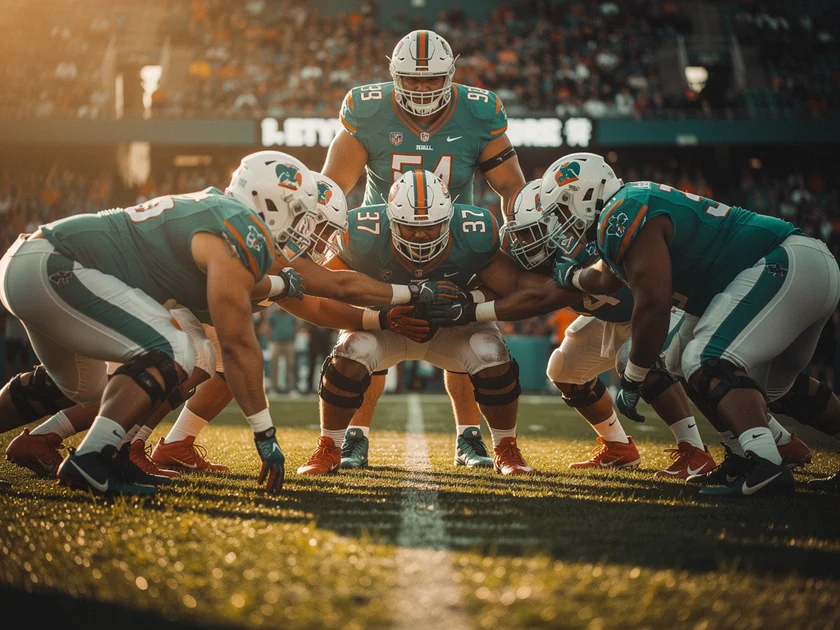
Los Angeles Chargers head coach Jim Harbaugh signed fullback Alec Ingold on Sunday night, a move that crystallizes the NFL coaching philosophy Harbaugh has carried from Michigan to the NFL sideline. The deal is valued at $7.5 million, a striking investment in a position most franchises have quietly abandoned over the past decade.
Ingold, 28, spent three seasons with the Las Vegas Raiders before logging four more with the Miami Dolphins, where he was due to earn $3.55 million in 2026 before the Dolphins released him. The Chargers moved quickly once Ingold hit the open market, and the timing of new offensive coordinator Mike McDaniel’s arrival from Miami almost certainly accelerated the decision.
Breaking down the advanced metrics, fullback usage correlates tightly with run-game efficiency in 12 and 21 personnel groupings — the exact formations Harbaugh leaned on at Michigan and has steadily reintroduced to the Chargers’ snap count since taking over in 2024. The numbers suggest this signing is less a sentimental nod to old-school football and more a calculated scheme fit.
NFL Coaching Context: Why Harbaugh Values the Fullback
Harbaugh’s NFL coaching identity has always centered on establishing a physical run game, and the fullback is the keystone of that architecture. Most modern offenses have abandoned the position entirely in favor of spread formations and empty backfields, but Harbaugh’s system demands a lead blocker who can also threaten in the flat and on play-action. Ingold is widely regarded as one of the two or three best active fullbacks in the league.
Tracking this trend over three seasons of Harbaugh’s tenure with the Chargers, the team has consistently prioritized personnel that supports a power-run scheme — tight ends, blocking backs, and interior linemen who can generate movement at the point of attack. Ingold fits that blueprint precisely. His ability to align in multiple spots, function as a lead blocker in short-yardage situations, and serve as a checkdown valve out of the backfield gives offensive coordinator McDaniel genuine formation flexibility. That versatility matters enormously in a West Coast system that relies on pre-snap motion and misdirection to generate favorable matchups.
The McDaniel Connection: How Miami’s Loss Became LA’s Gain
Read more: New York Giants Chasing Outrageous Free
Mike McDaniel’s move from Miami head coach to Chargers offensive coordinator created a direct pipeline to Dolphins personnel, and Alec Ingold is the first tangible product of that relationship. McDaniel coached Ingold in Miami for multiple seasons and understands precisely how to deploy him within a scheme that blends zone-run concepts with West Coast passing principles. The Dolphins’ decision to release Ingold — saving $3.55 million against their 2026 cap — opened a door the Chargers walked straight through.
McDaniel’s offensive system in Miami consistently ranked among the league’s more creative run-game designs, using motion, jet sweeps, and fullback lead plays to stress defensive alignments laterally before attacking downhill. Bringing Ingold into that same system, now installed in Los Angeles, means the fullback won’t need an extended adjustment period. He already knows the language. That institutional familiarity — a coach and a player who have already built trust within a specific scheme — is a genuine competitive edge that raw talent evaluations rarely capture.
What Does the Ingold Signing Mean for the Chargers’ 2026 Offense?
The Ingold signing reinforces the Chargers’ commitment to a run-first offensive identity under quarterback Justin Herbert, whose play-action efficiency improves measurably when defenses respect a genuine ground threat. Adding a fullback of Ingold’s caliber directly expands the team’s 21 and 22 personnel packages, creating heavier formations that force opposing defenses to sub out nickel and dime packages — a structural advantage on early downs. Based on available data from the 2024 season, the Chargers ranked in the middle tier of the league in rushing yards per carry, suggesting room for meaningful improvement if the run-game infrastructure continues to develop.
One counterargument worth considering: investing $7.5 million in a fullback carries real salary cap implications in a league where that money could fund a rotational edge rusher or a slot receiver with legitimate target share. The Chargers are betting that Ingold’s schematic value — the hidden yards he generates for other ball carriers, the protection he provides on play-action bootlegs — justifies a price tag that would have seemed absurd to most front offices five years ago. It is a defensible bet, but not a risk-free one.
Key Developments in the Chargers’ Fullback Signing
Read more: Raiders Reveal NFL Coaching Staff for
- Ingold was released by the Miami Dolphins before the Chargers signed him, with Miami cutting him to avoid paying his $3.55 million 2026 salary.
- The $7.5 million contract represents one of the largest fullback deals in recent NFL free agency history, reflecting Harbaugh’s willingness to allocate premium resources to a devalued position.
- Mike McDaniel, now the Chargers’ offensive coordinator, served as the Dolphins’ head coach during Ingold’s four seasons in Miami — giving McDaniel direct firsthand knowledge of Ingold’s skill set and limitations.
- Ingold’s professional career spans seven NFL seasons across two franchises — three with the Las Vegas Raiders and four with the Dolphins — before arriving in Los Angeles.
- Harbaugh is credited as a key figure in recruiting Ingold to the Chargers, suggesting the head coach was personally involved in the free agent pursuit rather than delegating it entirely to the personnel department.
NFL Coaching Philosophy and the Fullback Revival
Jim Harbaugh’s decision to spend $7.5 million on a fullback is not an isolated quirk — it reflects a broader NFL coaching philosophy that views personnel investment as scheme investment. The film shows that defenses aligned against 21 personnel (two backs, one tight end) must account for gap-blocking assignments that simply do not exist against spread formations, forcing linebackers into pre-snap conflict and creating natural play-action opportunities for Herbert downfield.
The Chargers’ front office brass, operating under general manager Joe Hortiz, has consistently supported Harbaugh’s personnel preferences since his arrival. Hortiz and Harbaugh have built a roster that skews toward physicality and scheme coherence rather than chasing individual star power at every position. Ingold’s signing extends that draft strategy and free agency analysis approach into the 2026 offseason, signaling that the coaching staff intends to deepen its commitment to a run-game identity rather than pivot toward the pass-heavy schemes that dominate the AFC West. Whether that approach closes the gap with the Kansas City Chiefs — who have won the AFC West in nine of the last ten seasons — will define Harbaugh’s tenure in Los Angeles.
How much is Alec Ingold’s contract with the Los Angeles Chargers?
Alec Ingold signed with the Los Angeles Chargers for $7.5 million, according to reporting from The Sporting News. The deal came after the Miami Dolphins released Ingold rather than pay his scheduled $3.55 million 2026 salary, making him an unrestricted free agent available to any team willing to meet his market value.
Why did the Miami Dolphins release Alec Ingold?
The Dolphins released Ingold ahead of the 2026 season to clear his $3.55 million salary from their cap ledger. Miami’s decision came after the franchise parted ways with head coach Mike McDaniel, who had been Ingold’s primary advocate within the organization. McDaniel subsequently joined the Chargers as offensive coordinator, creating the connection that led directly to Ingold’s signing in Los Angeles.
What is Jim Harbaugh’s coaching record with the Los Angeles Chargers?
Jim Harbaugh joined the Chargers in 2024 after a highly successful run at the University of Michigan, where he won a national championship. His first season in Los Angeles produced a playoff appearance, ending a multi-year postseason drought for the franchise. The 2026 offseason represents his third year building the roster toward his preferred power-run offensive scheme.
Who is Mike McDaniel and what is his role with the Chargers?
Mike McDaniel is the Los Angeles Chargers’ offensive coordinator for the 2026 season, hired after serving as the Miami Dolphins’ head coach. McDaniel built a reputation in Miami for creative zone-run designs and motion-heavy play-calling. His four-season overlap with Ingold in Miami means the Chargers’ new offensive coordinator already has an established working relationship with the fullback he will now deploy in Los Angeles.
Is the fullback position making a comeback in the NFL?
Based on available roster data, the fullback position remains rare across the league, with fewer than a dozen teams carrying a true in-line fullback on their 53-man roster in recent seasons. Harbaugh’s willingness to commit $7.5 million to the position is an outlier, not a trend. A handful of other run-heavy coaches — most notably those running gap-scheme offenses — have maintained the position, but the broader league has moved decisively toward spread and 11 personnel groupings.