

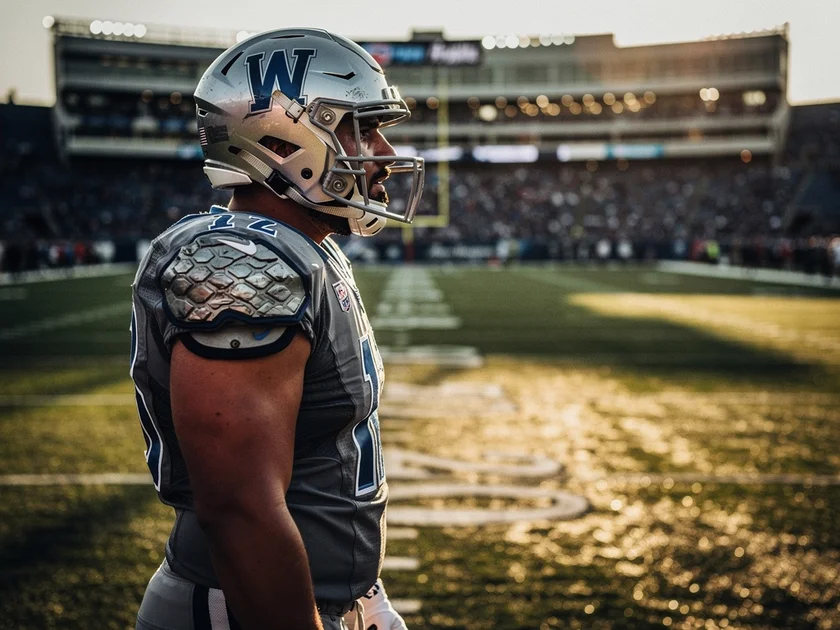
AJ Epenesa’s six-year tenure with the Buffalo Bills has formally concluded without a new home, after the Cleveland Browns opted not to finalize a previously agreed-upon contract following his physical on March 30, 2026. The Browns had struck a one-year deal worth up to $5 million with the defensive end on March 18, only to walk away after an in-person evaluation raised concerns serious enough to kill the agreement entirely.
For Buffalo, the development closes a chapter on one of the more quietly productive depth pieces of the Bills’ recent defensive line rotation. Epenesa never cracked the starting lineup with consistency, but his snap count and rotational reliability over 91 career games spoke to a durability and scheme versatility that Brandon Beane’s front office valued across multiple seasons.
How Did AJ Epenesa’s Buffalo Bills Career Unfold?
Epenesa’s path in Buffalo began as a second-round selection in the 2020 NFL Draft and stretched across all six of his professional seasons with the organization. Over that span he appeared in 91 games and made 19 starts, carving out a role as a reliable backup edge rusher rather than a featured pass-rusher in Buffalo’s 4-3-based defensive scheme.
Breaking down the advanced metrics from his Buffalo tenure, Epenesa’s value was most apparent in his ability to absorb snaps against the run without surrendering gap integrity — a requirement in Leslie Frazier’s and later Bobby Johnson’s defensive fronts. He was never a double-digit sack threat, but the numbers suggest a player whose DVOA contribution in run defense consistently outpaced his pass-rush production. That profile — high-floor, low-ceiling — is precisely the archetype that cap-conscious rosters like the Bills’ depend on to maintain defensive line depth without committing top-tier cap space.
The Bills drafted Epenesa out of Iowa, where he was regarded as one of the more physically imposing edge prospects in his class. At 27, he entered free agency this offseason as a veteran with starter-level experience but backup-level market value — a combination that made the Browns’ reported $5 million offer look like a fair, if modest, reflection of his standing.
Cleveland Browns Physical: What Went Wrong?
The Cleveland Browns declined to complete the deal after Epenesa visited their facility the Monday before the announcement, per the NFL’s transaction wire. The team grew uncomfortable finalizing the agreement following the physical examination, though the specific medical concern was not disclosed publicly. Physicals derailing free-agent signings are uncommon but not unprecedented in the NFL — teams retain the contractual right to void agreements when medical evaluations surface issues that weren’t apparent during initial negotiations.
The Browns had agreed to the one-year deal on March 18, with ESPN’s Adam Schefter reporting the terms at the time. The roughly 12-day gap between the agreement and the facility visit is notable — Cleveland’s medical staff had time to review prior injury history before the in-person evaluation, which makes the decision to void the deal after the physical particularly pointed. Based on available data, the Browns’ decision reflects a level of medical concern significant enough to override what was already a modest financial commitment.
One counterargument worth raising: teams occasionally use physical concerns as a negotiating lever to renegotiate terms downward rather than walk away entirely. Without confirmation of the specific medical finding, it is impossible to determine whether Cleveland’s exit was purely precautionary or whether it reflected a more serious structural concern about Epenesa’s long-term availability.
Buffalo Bills Defensive Line Depth Chart Impact
The Buffalo Bills’ defensive line depth chart enters April with a notable vacancy at the backup edge position that Epenesa occupied for years. Greg Rousseau and A.J. Epenesa had functioned as complementary pieces in Buffalo’s rotation, and with Epenesa now unsigned, Beane faces a decision about whether to address that void through the NFL Draft, a late free-agent addition, or internal development of younger players already on the 53-man roster.
Buffalo’s salary cap implications from Epenesa’s departure are negligible — he was a free agent, carrying no dead money — but the roster construction question is real. The Bills have invested heavily in their defensive line over the past three drafts, and the 2026 NFL Draft presents an opportunity to add a developmental edge rusher who can grow into the rotational role Epenesa vacated. Tracking this trend over three seasons, Buffalo’s front office has consistently prioritized edge depth in the middle rounds, a draft strategy analysis that suggests they won’t panic-sign a stopgap at a premium price.
Greg Rousseau’s continued development as a primary pass-rusher means the Bills are not desperate. But depth is the currency of a long playoff run, and Epenesa’s absence removes a known quantity from a unit that will need fresh bodies if Buffalo intends to push deep into the postseason in 2026.
Key Developments in the Epenesa Situation
- Epenesa and the Browns agreed to a one-year deal on March 18, with the contract carrying a value of up to $5 million.
- Epenesa visited Cleveland’s facility the Monday before the deal collapsed, per the NFL’s official transaction wire — meaning the physical took place approximately one week after the initial agreement.
- ESPN’s Adam Schefter first reported the original agreement between Epenesa and Cleveland.
- Epenesa recorded 19 starts across his 91-game Bills career, indicating he functioned primarily as a rotational piece rather than a full-time starter.
- Buffalo selected Epenesa in the second round of the 2020 NFL Draft, making him one of the longer-tenured players from that draft class to remain with his original franchise before entering free agency.
What Comes Next for Epenesa and the Bills’ Roster?
AJ Epenesa now re-enters the free-agent market at age 27 with a failed physical on his recent record — a complication that will likely suppress his market value further and narrow the field of interested teams. Veteran defensive ends with physical question marks tend to find work on prove-it deals or practice squad arrangements rather than the kind of one-year, incentive-laden contracts that Cleveland originally offered.
For the Bills, the offseason defensive line breakdown now runs through the draft and any remaining mid-tier free-agent options. Buffalo’s front office brass has shown a preference for building through the draft rather than overpaying in free agency, a philosophy that Beane has maintained even during the team’s Super Bowl contention window. The 2026 NFL Draft, scheduled for late April in Green Bay, offers multiple rounds where edge-rusher depth could be addressed without compromising the cap space Buffalo needs to retain its core offensive weapons around Josh Allen.
The numbers reveal a pattern across Beane’s tenure: Buffalo rarely re-signs its own rotational defenders once they reach free agency, preferring to cycle in younger, cheaper alternatives. Epenesa’s departure fits that model precisely. Whether the Bills find a comparable replacement — a player who can hold up against the run, generate occasional pressure, and stay healthy across a 17-game schedule — will be one of the quieter but consequential roster questions of the 2026 offseason.
Why did the Cleveland Browns back out of the AJ Epenesa deal?
The Browns grew uncomfortable finalizing the one-year contract after Epenesa’s physical at their facility, according to ESPN. The specific medical concern was not publicly disclosed. Teams can void agreed-upon deals when physical examinations reveal conditions not previously known, and Cleveland exercised that right despite having already announced the agreement on March 18.
How many seasons did AJ Epenesa play for the Buffalo Bills?
Epenesa played all six of his NFL seasons with Buffalo, spanning from his second-round selection in the 2020 NFL Draft through the 2025 season. He appeared in 91 games during that stretch, making him one of the more durable rotational defensive linemen in the Bills’ recent history despite never fully claiming a starting role.
What was the value of the deal between Epenesa and the Browns?
The Browns and Epenesa agreed to a one-year contract worth up to $5 million, per ESPN’s Adam Schefter. The incentive-laden structure — indicated by the “up to” framing — suggests a base salary below that ceiling with performance escalators, a standard structure for veteran depth players entering their age-27 season on the open market.
How does Epenesa’s departure affect Buffalo Bills salary cap space?
Epenesa’s exit carries zero dead-cap consequence for Buffalo because he was an unrestricted free agent whose contract had already expired. The Bills owe him no cap charge in 2026. Based on publicly available cap data, Buffalo entered the 2026 offseason with meaningful flexibility — enough to address the defensive line vacancy through free agency or a mid-round draft pick without straining their cap structure around Josh Allen’s contract.
Where was AJ Epenesa drafted and what college did he attend?
Buffalo selected Epenesa 54th overall in the second round of the 2020 NFL Draft out of the University of Iowa. At Iowa he was considered one of the premier power-based edge rushers in his class, projecting as a run-stopping specialist with developing pass-rush technique — a profile that accurately predicted his professional role across six seasons in Buffalo’s defensive line rotation.

Leave a Reply